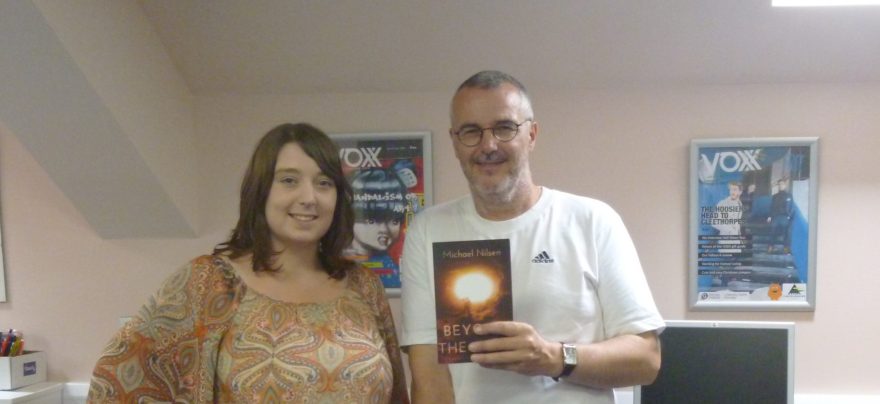
A FACE TO FACE INTERVIEW IN THE VOXX OFFICE WITH A LOCAL AUTHOR
Following from our interview for VOXX Issue [#], I had the pleasure of sitting down with local author Michael Nilsen to chat about his new book, Beyond the Cave, a compilation of poems and short stories. Michael once worked on the docks, and then went on to be involved in the world of boxing, but now his focus has shifted to a less physically demanding pursuit, but passion all the same.
So Michael, what’s been happening since we last spoke?
The last 18 years I’ve been studying on and off with a view to teach as a college lecturer, with mature students post 16. It’s been a dream job that I’ve aspired to, but it’s quite competitive to get in, because I’m not as experienced as other teachers; I only got my PGCE in 2014 and I’ve been concentrating mostly on my writing since then. But I contacted Franklin College because I wanted to see if they were interested in me doing a poetry performance, and they suggested because I was a published author that I could come in to talk about writing my new books to try and inspire the students. So I went in to do my kind of motivational speech for a day and I saw about four or five different classes, and the lady who invited me recently emailed me, maybe two or three months ago, that there was a job going at Franklin College in the evenings. It was lecturing for English Language GCSE for mature students. I thought, I won’t get this, but I’ll apply. Anyway, I got an interview. I researched and prepared for this interview like I’d never done before, because I knew it was a golden opportunity, but I wasn’t getting my hopes up. So I went into the interview and it went really well and they phoned me up that evening and they said they were aware I was inexperienced, but they thought with the right support I could make a real go of it. I just couldn’t believe it; I’ve been waiting for this for years. So I start in September as a college lecturer at Franklin College.
So you’re really looking forward to it?
Absolutely, I’ve been preparing on and off through the summer; it’s just exactly what I want to do, and it’s the subject that I’m most interested in.
So you’re actually glad you’re doing this now, rather than the kinds of manual jobs and docks and things that you did in the past?
I couldn’t go back to them because they were quite physical, and the nice thing about this is that I can enjoy the summer; there’s something to look forward to.
And what made you want to write this book specifically?
Well, I’ve been going into schools doing poetry performances and workshops, and it’s quite unnerving actually. You walk into a school assembly and there’s 100-200 kids there, and you’ve got to engage them. And I remember once when I was at Welholme, afterwards the teacher said, “You know what, you might not have seen it but all the kids were totally concentrating on you. They were so attentive, hanging on your every word.” And I’ve been in quite a lot of schools and had great responses from the kids, because for me they’re honest critics; they wear their hearts on their sleeves and I’ve been getting really positive feedback from them. I’ve also been integrated into the local poetry scene and I’ve performed my poetry at Moon on the Water twice now, and also at the No.1 Pub. A couple of weeks ago I was even at Keelby Women’s Institute, and they were wonderful. I was performing in front of about 35-40 women and I even wrote a poem specially for it about Jam, because they’re known for making jam, and they thought that was funny. Because I’ve been getting this immediate feedback from it you can gauge what they like and don’t like in your writing, and it was encouraging; it just gave me further incentive to continue writing, so these last two years have been inspired by the reactions I’ve got when I read in public.
What is it about poetry in particular as opposed to prose that interests you so much? Because you’ve done a lot of poetry.
Yeah, I have. Actually, William Wordsworth said, “There’s no difference between good prose and poetry.” If you write good prose well, you’re using poetical devices, but the reason I stick more to poetry is because maybe I have an element of impatience in me. I want to write it and see it finished. Sometimes I rigorously redraft it, but I like the immediacy of the expression; it’s condensed and you can complete a poem in a single sitting.
And why did you choose Beyond the Cave as the title for this book?
Beyond the Cave, it’s a reference to Plato. When I first started getting really into reading I was recommended to read The Last Days of Socrates, but also Plato’s Republic, and Plato uses the cave as a symbol of the idea he’s trying to convey. He says to picture a man chained to a rock in a cave, looking at shadows on the walls. He’s lived there all his life, and he thinks these shadows are real and the absolute representation of life. But because he’s never been allowed outside, he doesn’t realise these shadows are being made by the objects outside the cave, and if he went outside his whole perception would widen and he would marvel. So I used Beyond the Cave because it’s a poet’s duty to try and pierce below the surface of things to realise their essence. Poets try and hone their observational skills to see deeper into life, into the environment.
So, is there a recurring theme through this book or is it just bits and pieces from all different genres and events?
Well I see the painting on your wall is signed by The Motley Crew, and you could say that’s similar to my poetry. It’s a right mishmash. There are many different styles and themes and I’m looking through it and each poem is like a different person wrote it, and that’s what I was trying to go for. There’s no consistent theme or style; I was trying to be as varied as I could be.
And is there any element of this book you’re particularly proud of? Anything that really stands out?
I remember when I started writing in 1993 I was very enthusiastic, and I thought I was going to be the Jim Morrison of poets. I sent my poetry off to a lot of magazines, probably about 20 or 30, and they all rejected me, but I carried on writing for a bit. Then I thought, I’ve lost my momentum, I’ve written about everything that I needed to say. I was passionate about environmental issues particularly and I thought, I’ve said that now, anything else I’ll just be repeating. So I thought I’d genuinely stopped writing poetry and it was for good. So one of the things I’m proud of is that I keep coming up with new ideas for writing.
So are you planning on doing another one then?
Well I’m already writing, but I’m not going to publish it for another couple of years. I’m going to take my time and compile, because what I’ve been doing with this one, I don’t think I’m strict enough with the quality. I’ve just put every thought and idea in it, and I’ve been really a bit lenient with the quality. There is some great work in there, but when I read it I think that maybe I could have left some out. I’m writing consistently and I think I’m gradually still improving as a writer, and I’m writing in a different way now; I’m maturing. Because it’s been so consistent these last two to three years, I’ve been reading rigorously into different books, because that can obviously inform your writing. So I’ve still got things to say and I’m still improving.
So you’re just going to keep writing as long as you can?
Yeah, until I dry up I think, or I lose the motivation, and I’m hoping that I never will. I’m a fairly private guy and I spend a lot of time on my own, which is ideal for writing, so I think I’ll always have something to say. Hopefully.
Other than just continuing to write, do you have anything big planned for the future, or are you just seeing how things go for now?
Well, I’ve had this idea in my head for a while about a journeyman boxer who’s connected to the underground; he’s like, I don’t know, a money collector? There’s parallels to the Rocky franchise, but it’s going to be completely different. He’s a drug addict, and he boxes at the same time, but he’s not reaching his full potential because of his lifestyle and environment. So I’ve got this idea that I want to write maybe a novella or a novel about that, because I can utilise my own boxing experiences from when I spent over four years in boxing gyms and competitive boxing. So I can draw on those experiences. And in this book I’ve written some boxing recollections. When I was on my degree I did a biographical and autobiographical module, and one of the assignments was to write an episode in our own lives. And I focussed on my boxing. I used a typewriter when I was doing my degree, and I wrote it in maybe about 1997. It was left in a box until last year and I pulled it out and I thought, this is a good story, but I could see how I’d improved since then, and I thought I could redraft it. So I typed it out on the computer and added extra memories that I had and embellished on it, and it’s the centrepiece of that book actually, so I’m quite pleased with it.
So on the publishing side, is it the same publishers that published your other books?
Yeah, we’re used to how each other works now, they’re very efficient, they’re very responsive. I email them and you can guarantee they’ll get back to me the same day or the next day. They’re very understanding, and there were one or two stories in there that I was unsure whether or not to include. One’s called Kakos, and I thought it was a bit near the knuckle, a bit explicit, and he’s a very unsavoury character. What I was doing is I was exploring what Carl Jung calls “The Shadow”. Everybody’s got it, this dark side, and we’re supposed to try and integrate it to become more whole, but some people reject it and they become unbalanced. So I was exploring the dark side of my character through this writing, and I thought, I don’t know if I want to include it. I kept thinking about my mother reading it and things like that, and I said, “Will you read it carefully, that particular story, and tell me if you think I should include it.” And they read it, and they couldn’t see any problems with it. My mother did read it and she thought it was a bit explicit, but I thought, I’m not just writing for you. I’m trying to appeal to as wide an audience as I can, and I’ve got to say that some short stories and poems in there won’t appeal to everybody, but I like to think there’s something for everybody.
 VICTORIA HYDES